PFAS in Semiconductor Manufacturing
Learn how advanced waste gas and water treatment solutions can help tackle PFAS emissions and support cleaner, more sustainable chip manufacturing.

PFAS: Recognising Responsibility and Enabling Solutions
The burden of persistent chemicals on European water bodies has been one of the key environmental challenges of recent decades. Particular focus is on per- and polyfluoroalkyl substances (PFAS). PFAS is a group of substances used in numerous industrial applications due to their water-, grease- and dirt-repellent properties. In semiconductor manufacturing, PFAS are primarily used as process chemicals and membranes in etching, cleaning and filtration processes. The downside is that PFAS are extremely persistent in the environment and are associated with significant health and environmental risks. Against this backdrop, the European Commission is pushing for strict regulation. For many companies, this raises the question of how responsibility and technological feasibility can be reconciled.
PFAS as a systemic environmental problem
PFAS comprise several thousand individual substances used in products such as fire-fighting foams, coatings, textiles and electronic components. The high chemical and thermal stability that makes them so valuable in practical terms also leads to serious environmental consequences:
Persistence: PFAS hardly break down in the environment.
Bioaccumulation: They accumulate in organisms and food chains.
Toxicity: Many PFAS are suspected of being carcinogenic or endocrine-disrupting and of causing liver damage.
According to data from the European Environment Agency (EEA), between 2018 and 2022 around 51–60% of European rivers exceeded the limit values for PFOS. PFOS are one of the most commonly used PFAS compounds. A study by the European Commission’s Directorate-General for the Environment (DG ENV) from January 2026 finds that current PFAS pollution could cost the EU around €440 billion by 2050.
The European Water Strategy in the Changing Regulatory Framework
The EU is pursuing a far-reaching regulatory approach to PFAS, modelled on the REACH Regulation. The plan is to include this group of substances in the list of restricted substances, using a broad definition to cover future variants as well. Implementation is to take place in stages, with transition periods and exemptions for essential applications, such as in medical technology or the semiconductor industry.
A key instrument is the Drinking Water Directive (EU) 2020/2184, which sets binding limit values: 0.1 µg/L for individual PFAS, 0.5 µg/L for the total concentration. The aim is to safeguard the quality of drinking water in the EU in the long term.
To support this, the EU is planning a large-scale remediation initiative. Through public-private partnerships, innovative technologies for the treatment of PFAS-contaminated water are to be developed and implemented. This is where DAS Environmental Experts (DAS EE) comes in.
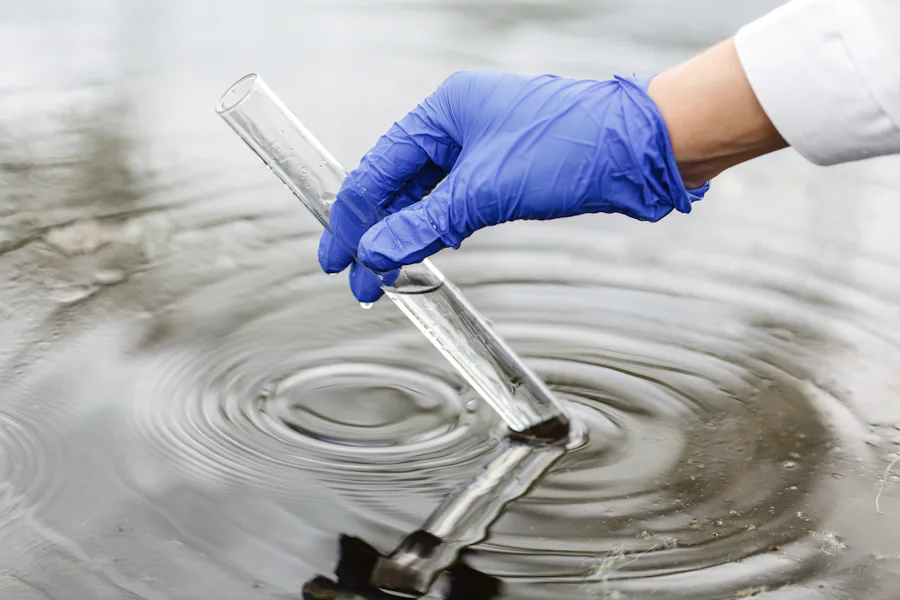
DAS EE’s Approach to Reducing Pollutants through Targeted Wastewater Treatment
As viable substitutes for many PFAS applications are not yet widely available, the current focus is on reducing PFAS emissions into the environment. DAS EE supports industrial stakeholders with proven methods for treating wastewater containing PFAS, particularly in semiconductor manufacturing, where such substances are generated as a result of the manufacturing process, particularly in etching and cleaning steps.
The methods used include:
Membrane filtration
Adsorption processes (e.g. activated carbon)
Ion exchange and flocculation techniques
Biological treatment stages
These modular systems can be configured to suit specific processes, monitored continuously and optimised in terms of energy and media consumption. The aim is to ensure compliance with current limits and to prepare for future regulatory requirements. In addition, DAS EE offers integrated monitoring systems that enable the ongoing analysis and improvement of resource usage and efficiency.
The figures cited above illustrate that PFAS are not merely an issue relating to individual substances, but affect entire ecosystems, regulatory frameworks and industrial structures. This makes it all the more important to have sound technical solutions that pave the way for phasing out PFAS-contaminated processes whilst also providing regulatory certainty.
