Optimization of Waste Gas Treatment Systems at the Point of Use
Optimization of Waste Gas Abatement at First Hand
Continuous Improvement for Future-Proof Waste Gas Treatment
High-tech industries are usually characterized by short innovation cycles. Along with designing new waste gas treatment systems, DAS Environmental Experts product developers continue optimizing and enhancing existing systems once the development process is complete. For the client, process optimizations very often cause changes in composition and quantity of process waste gases, thus leading to changing requirements regarding the waste gas treatment system. Changing industry standards for system components and modules also require continuous and further development in waste gas treatment systems.
To ensure each client receives continued development and improvement of our waste gas treatment solutions, we have established a CIP (Continuous Improvement Program) process, which enables the enhancement of system types or system modules through changes, supplements and new arrangements of single components and software. The CIP process monitors the entire system’s life cycle, from product development to commissioning and maintenance, supported by on-site FTIR (Fourier Transform Infrared Spectroscopy) measurements.
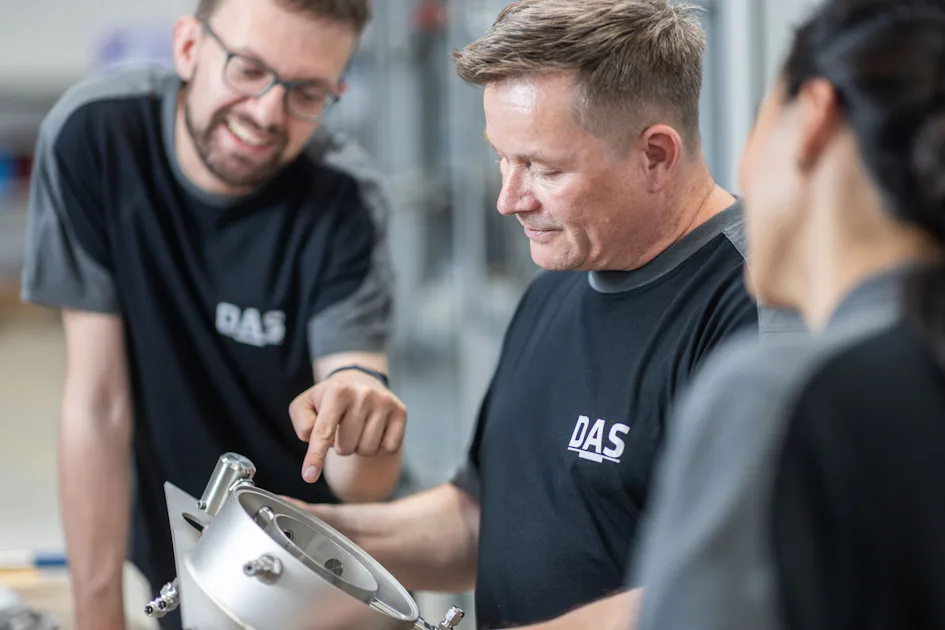
Our CIP Process for the Optimization of Waste Gas Treatment Systems
The improvement of our waste gas treatment systems is comprised of retrofitting existing systems and redesigning product families. Important to efficient optimization are client feedback and field data, which are regularly gathered and consolidated through our service and product management. We test larger technical changes either at our Dresden laboratory or, after consultation with our client, directly on site. Before adapting the system, documenting, or implementing the system’s improvement, we issue a notification of change to the client.
Do you have any questions about our products and services?
Our Environmental Experts will be happy to advise you - competently, individually and reliably.
Optimization of exhaust gas purification using FTIR measurements
To monitor the client’s waste gas treatment systems, DAS Environmental Experts utilizes FTIR (Fourier Transform Infrared) measurements. Our in-house FTIR spectrometer measures the waste gases’ in-and-outflowing concentrations at the process line. There are three different strategic reasons to perform this measurement:
1. Measuring the Efficiency of the Waste Gas Treatment System
In this procedure, the mass flow or mass concentration is measured after the waste gas treatment and by means of a specific process gas flow defined by the MFC (Mass Flow Controller). This procedure allows for efficient measurement of the waste gas treatment systems, and is a fast and easy measuring procedure. In addition, handling concentrated waste gases can be avoided.
2. Measuring the Overall Abatement Efficiency
In this variant, the mass flow rates of the process exhaust gases are measured after exhaust gas cleaning. This allows production emissions and atmospheric pollution to be determined. Process gases and by-products are also recorded. The method offers a simple and fast measurement routine without having to work with highly concentrated exhaust gases. The result shows the overall separation efficiency of the process, pump and waste gas purification, but does not provide detailed information on the efficiency of the waste gas purification system itself.
3. Measuring Emissions
This measuring procedure determines the mass flow after waste gas treatment during ongoing production and allows the capture of all process emissions and atmospheric load. This method, too, is easy to realize and does not require the handling of highly concentrated waste gases. The FTIR measurements provided by DAS Environmental Experts adhere to the specifications of each client’s waste gas treatment system, offer quality control, and serve as a reliable guideline for the continued optimization of our treatment systems. DAS EE also offers measurements in adherence to testing and certification institutes.
