Solutions for different types of fine dust pollution
Efficient solutions for fine dust pollution: DAS Environmental Experts delivers advanced technologies to reliably remove even the smallest particles — ensuring cleaner air and optimized industrial processes.

Reliable Waste Gas Treatment Eliminates Dangerous Gases
Avoiding dust emissions has been part of the philosophy at DAS Environmental Expert GmbH ever since it was first founded. In order to reliably eliminate dangerous gases, we offer very efficient burner-scrubber systems such as ESCAPE, STYRAX, UPTIMUM and TILIA. The scrubbing stage these include already reliably separates a large proportion of the solids. We keep working to develop this integrated technology further.
In addition, we offer two ranges of waste gas treatment systems, specifically designed for particle removal. Both are ideally suited for use as secondary systems after thermal processes to ensure clean waste air. These tried and tested technologies also undergo continual development – we take on every one of our customers’ challenges.
Solutions for Different Types of Fine Dust Pollution
The disadvantage of commonly available filtering separators is the loss of pressure through the filter. DAS Environmental Expert GmbH has therefore developed special electrostatic filters for waste gas disposal, primarily for use in the semiconductor industry, as well as a wet separator specially optimised for fine dust.
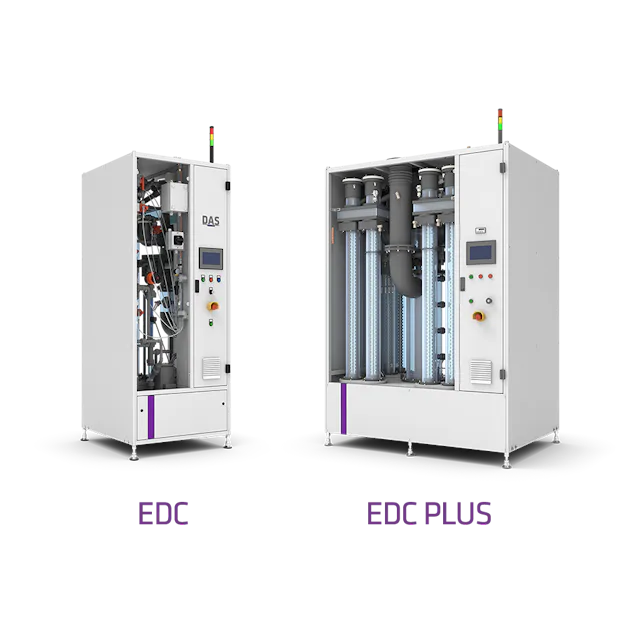
Electrostatic Fine Dust Collectors
The EDC and EDC PLUS systems are electrostatic dust collectors for point-of-use treatment of process waste gases that contain particles and aerosols. One system can treat waste gas volumes of up to 270 cubic metres per hour. These systems eliminate up to 99.9 % of fine dust particles, such as silicon oxide.
The pretreated process waste gases are first saturated with water and then fed through separator columns, where microparticles, nanoparticles and aerosols are ionised in an electrostatic field and then separated by a grounded film of scrubbing liquid on a rinsed wall. The separated dust is suspended in the scrubbing liquid; this prevents the dust particles from exiting the system and entering the cleanrooms and other sensitive production areas.
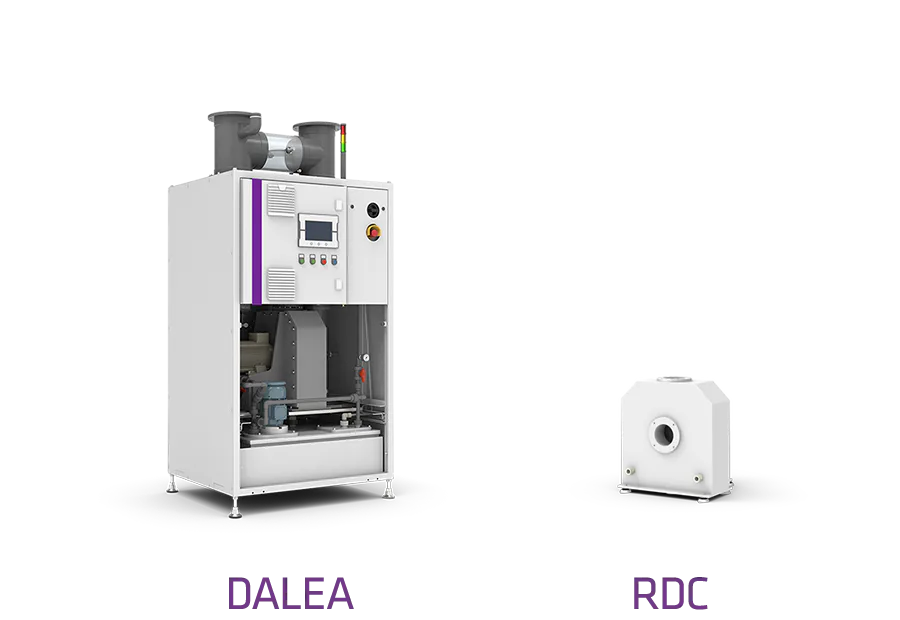
Rotary Fine Dust Collectors
The systems of the RDC range use centrifugal force to separate fine dust particles. They are based on the purely mechanical rotor-stator principle: A jet of water is atomised by a high-speed rotating disc. The result is a mist of very fine water drops in which dust particles are centrifuged. The rotor ensures that the waste gases are aspirated and thus moved forward without loss of pressure. The turbulence in the shear gap between the rotor and stator ensures that the water mist and particle-laden process gases are mixed together effectively. The fine dust particles are suspended in the water; the purified waste gas can then be released freely into the environment.
The RDC range was developed by DAS Environmental Expert GmbH in response to a client’s request. The systems are small, which means they can be integrated into or added to the classic burner-scrubber systems. The new model of this range, DALEA, can also be operated separately. RDC systems can also be used for much higher dust loads than the EDC systems, as well as for higher waste air flows. In addition, the rotor works as a blower and moves the waste gas forward; this prevents any loss of pressure and even supports the extraction that normally follows. However, RDC systems do not have the same degree of separation efficiency as the EDC range.
The RDC range offers solutions for production plants that create very high fine dust loads. It is an efficient extension of the EDC range; DAS Environmental Expert GmbH thus offers perfectly adapted solutions for different sectors and processes.